Teach a Cat to Follow a Target
Teach a short nose touch, then use it to guide voluntary movement onto a familiar surface without reaching for the cat.
7 min read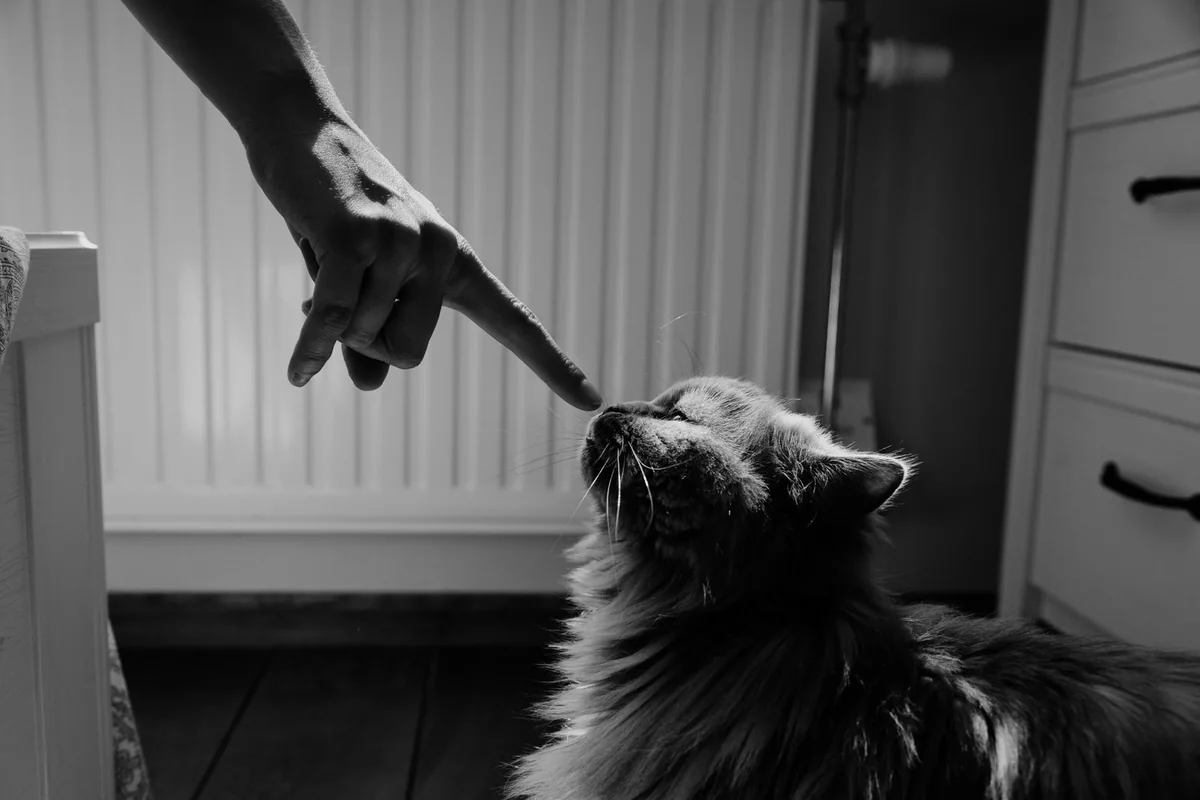
A cat is sitting beside you and follows a finger with their eyes. You lower your hand, and they lean forward to sniff. That is a reasonable starting point for target training. A target is an object the animal learns to approach or touch. Once the movement is familiar, you can invite the cat to take a step or move toward a mat without blocking the path or lifting them. The small skill can be useful anywhere both of you have time and space to practice.
Choose a specific end use. Perhaps you want to ask the cat to step onto a towel before moving the cushion they were lying on. Perhaps they already like their scratching board and you want to direct them toward its far edge during a game. A narrow goal keeps you from asking for harder movements before the first one is easy. Start on a level floor or another broad, stable surface where the cat can turn away.
Choose an object the cat can see and ignore
A short, smooth spoon handle or another plain hand-held object can work, provided it is too large to swallow, has no loose parts, and can be held still. If the cat tends to grab anything you offer, choose an object less like their usual toy. A fingertip can be convenient if the cat approaches hands gently, although some people prefer a separate object so they don't accidentally give the cue when pointing at something else.
Pick one part of the object for the touch. Hold it at a comfortable height and a short distance to the side, where the cat can see it easily. Approaching directly toward the cat's face can make the object difficult to avoid or uncomfortable to inspect. Keep your free hand still. If you bring the reward into view first, you may teach the cat to look for the food hand instead of examining the target.
Decide what will mark the desired moment. A soft, brief word such as “yes” can work if you use it consistently. Say it when the cat does the intended movement, then offer the reward promptly. Choose a reward the cat likes and can have. For a cat interested in food, use a small piece of something already appropriate for their routine. If the animal startles at a clicker, use a quieter marker rather than trying to make them stay close while it goes off.
Start with the smallest response you can see
Present the target once and wait briefly. An interested cat may turn their face or lean toward it. Mark that small movement, put the target away, and provide the reward. Give a pause before trying again. When the cat readily leans in, wait for a closer sniff. If they offer a gentle touch, mark the instant it happens. It is easy to reward the head turning away a moment later if the target stays out while you search for the food.
Watch how the cat approaches over several attempts. A quick sniff with paws relaxed is different from a rapid swat followed by pursuit of the object. If the animal starts batting the target, put it down and try again later with less motion. An object held still has a different feel from a toy that darts away. A cat who bites at the target may be better suited to a larger object or a different kind of reward game. Keep hands away if the game becomes too exciting.
End a session while the cat is still willing to come back. Three clear attempts are plenty to start. If there is no response, pick up the target and continue with your day. You can try again when the room is quieter, the cat is awake, and the distance is easier. A busy household can interrupt a simple learning task with a bowl scraping, a dog passing, or another cat jumping onto the same platform.
Introduce one step before a longer move
After the cat reliably touches the target within reach, hold it just far enough away that they can take one natural step. Keep it still and at the same height. Mark the touch and reward nearby. Repeat this at the same distance before trying two steps. When the cat does less, make the next attempt easier. A movement that takes them off a rug onto a slippery floor is a bigger change than the distance alone suggests.
Allow the cat to choose a straight approach at first. If the target moves around a corner or appears behind a chair leg, the route can become hard to see. Set up two familiar low surfaces side by side before asking for a transition. A towel placed flat on a firm floor is a good place to practice crossing a change in texture. Inspect the route for bunching fabric, unstable platforms, and obstacles near the landing if any step is involved.
You can use several short touches to guide a route across the room. Give the reward where the cat has just completed the movement, and offer a pause before presenting the target again. For a mat, put the target slightly over its nearer edge at first. Increase the distance until the cat can stand comfortably on the mat. Feed in a place that does not require them to turn abruptly or step off. Let them leave freely after the reward.
If you need to swap the spoon for another object, introduce the new object at the original distance. When the cat hesitates, let them inspect it on the floor and try the touch later.
Decide when a spoken cue is useful
The appearance of the object may already be a clear invitation. A spoken cue can help distinguish a practice attempt from an object you happen to be holding. If you want to add one, say the same short word once just before presenting the target, after the cat has learned the movement. Give the word meaning by making the following action predictable. Repeating the word while the cat is looking elsewhere gives very little information about what you want.
Test in another quiet room only when the original version is going smoothly. Start again at a short distance. The cat may be willing to touch a target near the chair where you always train and hesitate when it appears beside the kitchen bin. A different floor, your change in position, or the closeness of a second animal can account for the difference. Use the easiest version of the task to give the new place its own practice.
Different people can give the same cue if they hold the object in the same way and offer the reward at the right time. Demonstrate it with one or two attempts and describe what a successful touch looks like. A child can watch or practice under close adult supervision if the cat is comfortable and hands remain clear. The cat needs room to leave at any point, including after someone has said the cue.
Suppose the cat can touch the target while seated but loses interest once you ask for a step. Try two versions on different days. First present the object just beside the cat's nose while they are already standing, and reward one small forward movement. On the second day, keep the target close and practice in the same direction with a single step on the same surface. You may discover that standing up from the seat was the difficult part. Now you can teach the movement from a position the cat finds easier. Once a standing touch feels familiar, try a slight change of direction before adding distance. Keep the target at a height the cat can reach without having to lift their front feet from the floor.
Put the skill to work without making it an ambush
Use the target for ordinary small moves as well as for the particular job you had in mind. A cat who steps onto a mat and then always gets picked up can learn to avoid the mat. Let most trips end after the reward and a chance to walk away. If you want to use the skill near a carrier or another object the cat is uncertain about, practice the approach separately before adding any closing or handling. A successful target touch only tells you the cat was willing to make that movement.
Keep a tiny record if you are having trouble. A note such as “touches beside the chair, takes one step on carpet, turns away at kitchen tiles” tells you which element to adjust. Put the target away when you finish so that it remains a clear object when it appears again. You can practice with just one touch some days. Short repetitions on an easy setup will often give you a smoother response than several minutes spent trying to recover after the animal stopped engaging.
Eventually the useful moment will look plain. The cat approaches a towel, touches an object you hold steady, takes a reward, and stands in a place you can both use. Save more ambitious routes for a time when the animal seems interested in exploring. The cue belongs to a cooperative exchange, and its reliability depends on both the setup and the cat's continuing ability to choose.